This case study investigates the use of High Shear Melt Conditioning (HSMC) technology to increase degassing effectiveness and enhance the mechanical qualities of castings made of the A356 aluminum alloy (Lazaro-Nebreda et Al, 2021).
Currently, the most widely used technique for removing hydrogen from melts of aluminum alloy is rotary degassing. In this method, the degassing efficiency increases with the size of the purge gas bubble. However, in the traditional rotational degassing process, it is challenging to shrink the bubble size to less than 10mm in diameter. A smaller bubble size in the melt can be achieved by increasing the graphite rotor speed, but doing so results in melt flow turbulence and vortex creation near the melt's surface, which speeds up the absorption of hydrogen (re-gassing) from the atmosphere. It also increases the entrapment of dross in the melt, which lowers melt quality (Patel et Al, 2017)
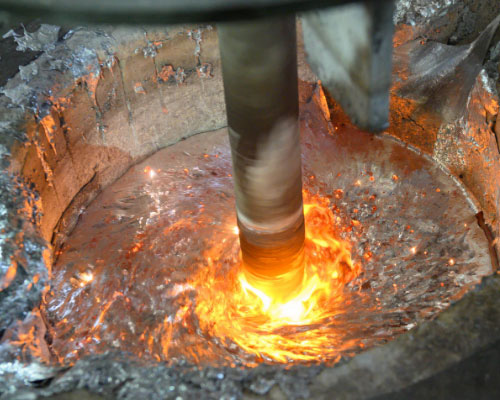
During the traditional rotary degassing of aluminum melts, argon or nitrogen gas is injected into the melt through a hollow graphite rotor that rotates at a low speed (about 500 rpm) in order to distribute the bubbles throughout the melt's volume uniformly. Each bubble is divided into numerous smaller ones when the graphite rotor is replaced with the new rotor-stator type high shear device, increasing the total surface area of the bubbles in the melt and enhancing the efficiency of degassing. The size of the argon/ nitrogen bubbles is reduced to about 1 mm in diameter, and their number density is increased. At the same time, the stator's design minimizes disturbance of the melt surface, which increases the degassing efficiency (Patel et Al, 2017).
Microstructure of A6082 aluminum alloy cast at 700°C (a) without melt shearing and (b) with melt shearing (Patel et Al, 2017).
Due to the resulting porosity, dissolved hydrogen in aluminum alloys is detrimental to the mechanical properties of castings. High shear melt conditioning (HSMC) technique based on rotor/stator disperses each argon bubble into numerous small bubbles, increasing the total surface area of bubbles in the melt while causing the least amount of surface disruption possible, thereby increasing the degassing efficiency. This led to several processing advantages over the traditional rotary degassing method, including a decreased argon flow rate from 5 to 20 liters per minute, to 0.1 liters per minute, decreased degassing times from 30 minutes to a few minutes, and most importantly, a decreased residual hydrogen content from 0.15 cm3/100 g to 0.04 cm3/100 g (Patel et Al, 2017).
Rotary degassing works well to remove hydrogen from melts but is ineffective in eliminating oxide bi-films. The HSMC degassing technology's ability to operate at greater speeds without generating surface turbulences allows it to efficiently remove both the hydrogen and the trapped oxide bi-films at the same time. This greatly raises melt quality and keeps it stable for a longer period of time after degassing. As a result, the rotational degassing procedure frequently followed by the addition of covering fluxes does not apply to the aluminum melt handled by the HSMC degassing technique. (Lazaro-Nebreda et Al, 2021).